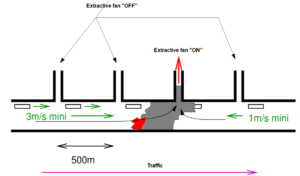
Depending on the conditions and the situations encountered in a tunnel, different air speeds and direction are applied and validated by the anemometer. The measurement of the anemometer is then used in a closed loop to control the speed of the fan.
Ventilation in road tunnels has three main objectives:
- To protect users as much as possible in case of a fire in the tunnel
- To limit the pollutant levels within the tunnel under normal operation
- To provide good dispersion conditions for the pollutants
Pollution
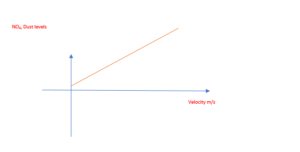
The ventilation enables dilution of the tunnel air by bringing in fresh air. Depending on the level of pollutant concentrations (e.g. NO₂ and dust) the ventilation fan will increase or decrease. The set point is given by the measurement of the anemometer. The polluted air is pushed towards one or the other of the entrances of the tunnel. The direction is confirmed by the anemometer which expresses positive or negative speeds.
The direction is confirmed by the anemometer which expresses positive or negative speeds.
Fire
For each fire position and back pressure, it is important to control the air speed by the control of the ventilation. Again, this is achieved very accurately through the anemometers.
Example: