

El VCEM5000/5100 representa la última generación de monitores de flujo únicos de CODEL.
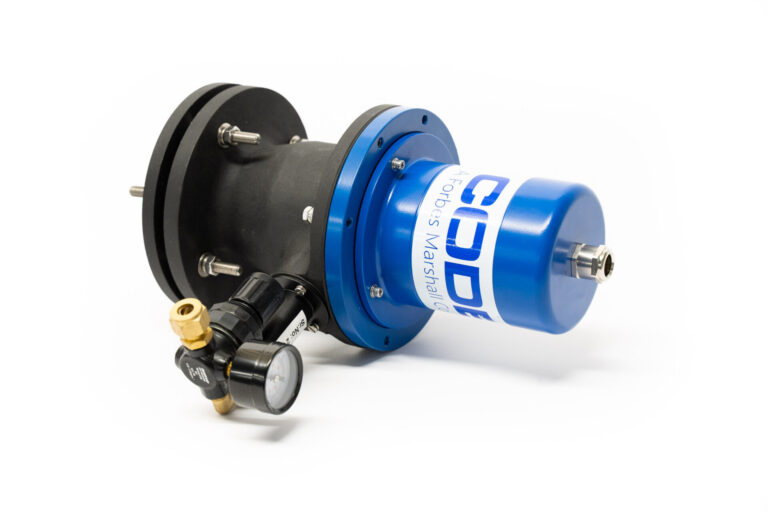
El VCEM 5000/5100 representa la última generación de monitores de flujo únicos de CODEL. Estos sistemas miden la velocidad de los gases de chimenea utilizando una medición de tiempo de vuelo altamente precisa que se deriva de un análisis de correlación cruzada de las emisiones infrarrojas del gas turbulento.
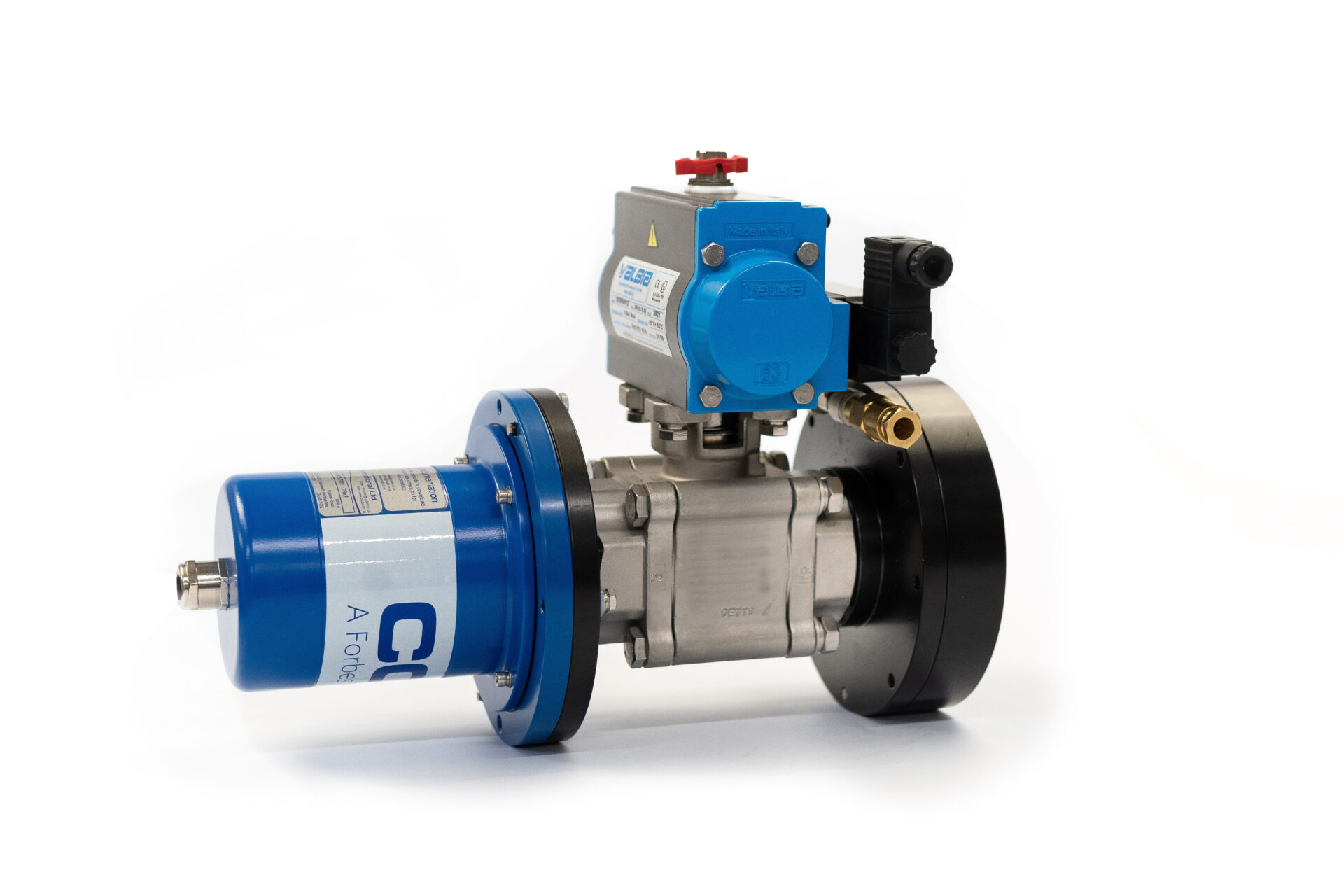
Para la detección principal se utilizan dos robustos detectores de infrarrojos, montados en la pila o conducto normalmente a 1 m de distancia en la dirección del flujo. Las cortinas de aire de alta eficiencia se instalan para prolongar considerablemente el tiempo entre el mantenimiento y los períodos y la limpieza de ventanas (generalmente 1 año).
El VCEM 5100 cuenta con las certificaciones TUV y MCERT, lo que significa la precisión y fiabilidad de sus capacidades de medición.
| Principio de funcionamiento | Correlación infrarroja |
| Unidades de medición | m/s, m3/s |
| Temperatura ambiente | De -20 °C a +50 °C |
| Fuente de alimentación | 48 V CC desde la unidad de procesador de señal (SPU) |
| Construcción | aluminio con recubrimiento epoxi según IP67 |
| Salidas analógicas | 2 salidas de corriente de 4-20 mA de serie, aisladas, 500 Ω de carga máxima, totalmente configurables desde el teclado |
| Salidas lógicas | 2 x contactos SPCO libres de voltaje, 50 V, 1 A máx., configurables como contactos de alarma1 x contacto SPCO libre de voltaje, 50 V, 1 A máx., para una señal válida de datos |
| Datos de serie | Protocolo RS485 MODBUS (opcional) |
The VCEM5100 is a continuous flue gas velocity monitor designed to measure the velocity and volumetric flow of gases in stacks and ducts. It can be used as a standalone flow monitor or as part of a complete Continuous Emissions Monitoring System (CEMS), supporting applications including combustion plants, cement plants, waste-to-energy, incineration, power generation and FGD processes.
The VCEM5100 uses infrared cross-correlation technology to determine the time of flight of naturally occurring infrared radiation within the turbulent flue gas. Two infrared detectors are positioned on the stack or duct, typically around 1 metre apart, allowing the system to calculate gas velocity without making physical contact with the gas stream.
Because the VCEM5100 sensors do not need to be inserted into the gas stream, there are no moving components exposed to the flue gas. This makes the technology particularly suitable for applications where high temperatures, dust loading or corrosive gases could make conventional flow measurement technologies difficult to maintain.
Yes. The VCEM5100 is designed for demanding high-temperature applications and CODEL states that it can operate with flue gas temperatures exceeding 1,000°C. This makes it suitable for applications where conventional flow measurement technologies may struggle with long-term operation.
Yes. The infrared correlation technique is designed to provide non-contact measurement even in challenging gas conditions. CODEL specifically highlights applications involving high dust loading and corrosive gases, including raw gas, SCR inlet/outlet and FGD inlet measurement.
The VCEM5100 is designed for low-maintenance operation. It has no moving components and uses high-efficiency air curtains to help keep the optical surfaces clean. CODEL states that this can typically extend the period between maintenance and window cleaning to around one year, depending on the application.
The VCEM5100 provides continuous measurement of gas velocity in m/s and volumetric flow in m³/s. It provides two configurable 4–20 mA analogue outputs as standard, with optional RS485 Modbus communications.
Yes. The VCEM5100 can operate as a standalone flow monitor or form part of an integrated CEMS. Its configurable analogue outputs, alarm/status contacts and optional RS485 Modbus communications allow the flow measurement to be integrated with wider emissions monitoring and data acquisition systems.
Yes. CODEL states that the VCEM5100 has received TÜV QAL1 certification, and the product page also identifies the VCEM5100 as both TÜV and MCERT certified.
Typical applications include:
It can also be used for process measurement in more demanding locations, such as raw gas and high-temperature process streams.
Yes. The non-contact measurement principle makes the VCEM5100 suitable for challenging process locations, including SCR inlet/outlet and FGD inlet applications. CODEL also identifies DeNOx and FGD monitoring among its flow-monitoring applications.
Yes, the VCEM5100 can form part of a US EPA-compliant emissions monitoring system where continuous flow measurement is required. US EPA Performance Specification 6 (PS-6) covers flow-rate measurement for continuous emission rate monitoring systems. CODEL states that the VCEM5100 can satisfy the requirements of 40 CFR Part 60, Appendix B, PS-6. The exact compliance requirements depend on the applicable EPA regulation, permit and application, so CODEL should confirm the appropriate configuration for each US project.
The key difference is the non-contact infrared measurement principle. Conventional technologies can require components to be exposed to the flue gas, whereas the VCEM5100 measures gas velocity remotely using infrared correlation. This means no moving parts are exposed to the gas stream and makes the system particularly attractive for high-temperature, high-dust or otherwise challenging applications.
Yes. The most appropriate flow-monitoring technology depends on factors such as stack or duct geometry, gas temperature, gas composition, dust loading, expected velocity range and the applicable regulatory requirements. CODEL can assess the application and recommend an appropriate configuration.
¿Buscas un manual?
Por favor contáctenos a continuación y estaremos encantados de ayudarle.
Para obtener más información sobre cualquiera de nuestros productos, rellene nuestro formulario de consulta y un miembro del personal le responderá lo antes posible.
También puede llamar al: +44(0)1629 814351
| Cookie | Duración | Descripción |
|---|---|---|
| cookielawinfo-checkbox-advertisement | 1 year | Set by the GDPR Cookie Consent plugin, this cookie records the user consent for the cookies in the "Advertisement" category. |
| cookielawinfo-checkbox-analytics | 11 months | This cookie is set by GDPR Cookie Consent plugin. The cookie is used to store the user consent for the cookies in the category "Analytics". |
| cookielawinfo-checkbox-functional | 11 months | The cookie is set by GDPR cookie consent to record the user consent for the cookies in the category "Functional". |
| cookielawinfo-checkbox-necessary | 11 months | This cookie is set by GDPR Cookie Consent plugin. The cookies is used to store the user consent for the cookies in the category "Necessary". |
| cookielawinfo-checkbox-others | 11 months | This cookie is set by GDPR Cookie Consent plugin. The cookie is used to store the user consent for the cookies in the category "Other. |
| cookielawinfo-checkbox-performance | 11 months | This cookie is set by GDPR Cookie Consent plugin. The cookie is used to store the user consent for the cookies in the category "Performance". |
| CookieLawInfoConsent | 1 year | CookieYes sets this cookie to record the default button state of the corresponding category and the status of CCPA. It works only in coordination with the primary cookie. |
| viewed_cookie_policy | 11 months | The cookie is set by the GDPR Cookie Consent plugin and is used to store whether or not user has consented to the use of cookies. It does not store any personal data. |
| _GRECAPTCHA | 6 months | Google Recaptcha service sets this cookie to identify bots to protect the website against malicious spam attacks. |
| Cookie | Duración | Descripción |
|---|---|---|
| TawkConnectionTime | session | Tawk.to, a live chat functionality, sets this cookie. For improved service, this cookie helps remember users so that previous chats can be linked together. |
| twk_idm_key | session | Tawk set this cookie to allow the website to recognise the visitor in order to optimize the chat-box functionality. |
| Cookie | Duración | Descripción |
|---|---|---|
| _ga | 1 year 1 month 4 days | Google Analytics sets this cookie to calculate visitor, session and campaign data and track site usage for the site's analytics report. The cookie stores information anonymously and assigns a randomly generated number to recognise unique visitors. |
| _ga_* | 1 year 1 month 4 days | Google Analytics sets this cookie to store and count page views. |
| Cookie | Duración | Descripción |
|---|---|---|
| VISITOR_INFO1_LIVE | 6 months | YouTube sets this cookie to measure bandwidth, determining whether the user gets the new or old player interface. |
| VISITOR_PRIVACY_METADATA | 6 months | YouTube sets this cookie to store the user's cookie consent state for the current domain. |
| YSC | session | Youtube sets this cookie to track the views of embedded videos on Youtube pages. |
| yt.innertube::nextId | never | YouTube sets this cookie to register a unique ID to store data on what videos from YouTube the user has seen. |
| yt.innertube::requests | never | YouTube sets this cookie to register a unique ID to store data on what videos from YouTube the user has seen. |